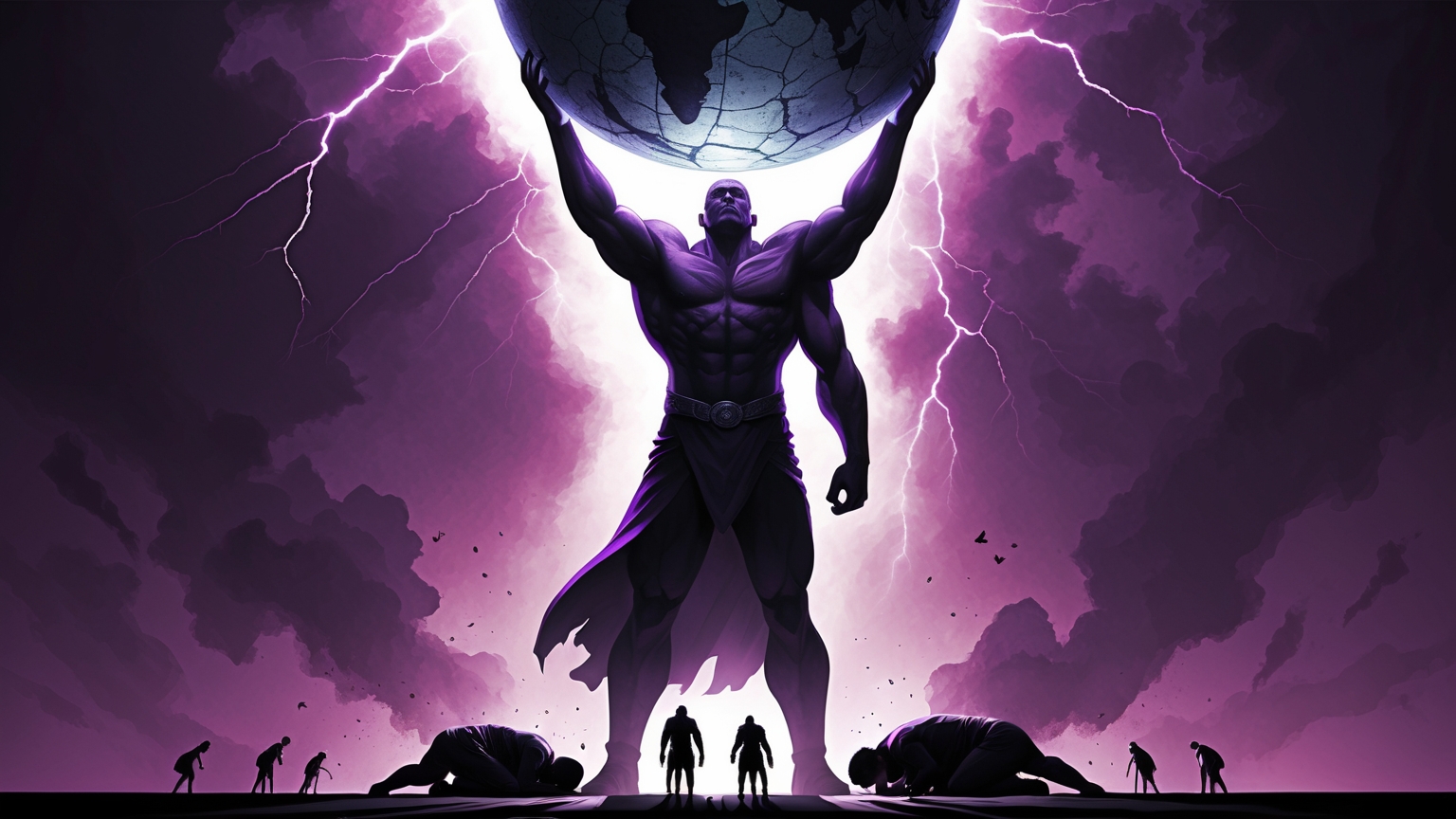
Every villain in this series believed they were the hero. That is not irony. That is the thesis.
Thanos did not claim to be the strongest, the smartest, or the most righteous. He claimed to have the will. "I'm the only one with the will to act on it." Not intelligence. Not power. Will — and by implication, no one else possesses it. That belief is not delusion. It is something far more dangerous: a psychological structure built on genuine capability, genuine suffering, and a catastrophic blind spot — the inability to conceive that the solution might be wrong, or that someone else's might be better. The savior complex is the engine that powered every mechanism examined in this series. Without it, the prophecy stays private, the logic stays theoretical, the certainty stays dormant. The savior complex is what converts insight into crusade.
The Messiah Complex: When Suffering Becomes a Mandate
Clinical psychology identifies the messiah complex as the belief that one is destined to save others — that personal suffering was not random but purposeful, conferring both the burden and the right to act on behalf of everyone else. It describes an identity architecture where the self is organized entirely around a salvific mission, and where the mission has become indistinguishable from the self.
Thanos described his work in explicitly salvific language. He was not conquering. He was saving. Only he understood the math. Only he had watched a civilization die from the disease he was now treating. Only he had paid the price — Titan, his people, eventually Gamora — that proved his commitment was real.
This is the internal logic of every messiah complex: suffering is reinterpreted as qualification. The pain was training. The rejection was the loneliness of the prophet. The losses were the cost of admission to a role no one else could fill. Robert Jay Lifton's research on totalist psychology documents this pattern in cult leaders, revolutionary figures, and authoritarian architects — the leader's trauma is narrativized into a story where suffering is the origin of authority. Challenge the mission and you dismiss the suffering that produced it. And dismissing someone's deepest pain is the one argument that never gets a fair hearing.
Indispensability Bias and the Strong Man Archetype
Mathew Hayward and Donald Hambrick's research on CEO hubris identified a mechanism that operates with disturbing predictability: past success amplifies the belief that the leader is personally irreplaceable. Thanos had culled populations on multiple planets and observed apparent stabilization. Each success reinforced not just the method but the indispensability of the person executing it. He stopped distinguishing between "this approach works" and "this approach works because I am the one doing it."
The political psychology of the strong man archetype follows the identical structure: a genuine problem, a conviction that only one person has the strength to solve it, and the framing of all opposition as weakness or blindness. "Only I can fix this" has been spoken by authoritarian leaders across centuries. The leader identifies a real threat, positions themselves as the singular bulwark, then redefines opposition — critics are not people with different solutions but people who lack the will to face the problem.
Thanos ran this architecture flawlessly. The resource crisis was real. His will was unique. And every voice of opposition — Gamora, the Avengers, entire civilizations — was categorized not as disagreement but as the same blindness that killed Titan. This is why the savior complex is a leadership pathology, not merely a personal one. It restructures the entire decision-making environment. Dissent becomes evidence of the problem the savior was called to solve. The feedback loop is closed. The system cannot correct itself because correction has been redefined as the disease.
Frankl's Paradox Inverted: When Meaning Justifies Suffering
Viktor Frankl argued that meaning sustains a person through suffering. His logotherapy demonstrated that humans endure extraordinary pain when connected to purpose. Thanos shows the dark inversion: suffering gave him his mission, and his mission gave his suffering meaning. The loop is self-sustaining and impervious to correction — because dismantling the mission would strip the suffering of its purpose, and purposeless suffering is the one state the human mind will do almost anything to avoid.
This operates everywhere. Nonprofit leaders who invoke personal sacrifice to deflect accountability. Parents who control their children "for their own good." Any leader who says "you don't know what I've given up" as a response to criticism.
Thanos wept when he killed Gamora. "It cost everything." That language repositions the perpetrator as the primary victim. The savior complex always includes this inversion: the person causing the most harm experiences themselves as bearing the greatest burden. Moral accountability dissolves — not through denial, but through genuine suffering that makes external judgment feel like ingratitude.
The Architecture of a Titan: Six Mechanisms, One System
This series has mapped six distinct psychological mechanisms. Each is dangerous alone. Together, they form a conviction system so complete that no external force can penetrate it.
Prophetic identity provides the foundation. The savior was right when no one listened. The wound becomes the credential.
Utilitarian logic provides the framework. The math is clean. Suffering is reclassified as an operational variable and the moral dimension vanishes.
Certainty locks the exit. The brain's reward system converts conviction into neurological addiction. "I am inevitable" is not confidence — it is the termination of reasoning.
Compartmentalized love allows selective emotion. The savior weeps for Gamora and snaps away trillions without contradiction — the emotional system partitioned into zones that do not communicate.
Self-radicalization removes external checks. The feedback loop between validated prophecy, isolation, and escalating conviction produces a closed system no new information can enter.
The savior complex provides the motivation that powers it all. Prophecy without mission is just memory. Logic without motivation is just theory. Certainty without purpose is just rigidity. The savior complex converts the architecture into action. It is the ignition key.
This is why Thanos was unstoppable. Six independent mechanisms aligned into a system with no seam, no gap, and no entry point for doubt. The system was not a belief. It was an identity — and identities do not update on evidence. They defend themselves against it.
The Protocol
The savior complex is built on real capability, real insight, and real sacrifice. The defense must be equally real — not aspirational humility, but structural architecture that operates when conviction is at its peak.
-
Institute the replaceability test on every critical initiative. Answer: "If I were removed tomorrow, could this succeed with someone else leading it?" If the honest answer is no, that is not evidence of your importance — it is evidence of a single point of failure. Build the system so it does not require you. A mission that dies without its founder was never a mission. It was a dependency.
-
Separate your suffering from your authority. Pain does not confer expertise. Loss does not confer wisdom. Ask: "Would I accept this argument from someone whose suffering produced a different conclusion?" If equivalent pain with an opposite solution would not carry equal authority, then suffering is not the source of your certainty — it is the disguise your certainty wears to avoid scrutiny.
-
Mandate structural dissent with real power. Not feedback sessions. Not devil's advocacy as performance. Appoint someone whose explicit role is to challenge core assumptions, with authority to delay or block action. The savior complex cannot survive genuine opposition from someone with institutional standing. Any serious decision framework includes this — because the framework exists precisely for the moments when the decision-maker's conviction is most dangerous.
-
Audit the cost narrative. When you cite what you have sacrificed as justification for your course of action, stop. "I have paid a price" is not an argument for "therefore my approach is correct." Separate the accounting of what you have given from the evaluation of whether what you are doing is working. The moment suffering becomes your argument, you have left reasoning and entered emotional immunity. Competitive intelligence operates on the same principle: resources already invested in a position must never determine whether the position is worth holding.
-
Practice collaborative humility as a discipline, not a feeling. Humility is a structural practice: the deliberate inclusion of perspectives that challenge your own, the active pursuit of people who reached different conclusions from similar data. Write down three people who disagree with your most important conviction. Seek them out. Listen without rebutting. If entertaining an alternative produces irritation or the thought "they just don't understand" — that reaction is the savior complex defending itself. The irritation is the diagnosis.
The Titan's Mirror
Six articles. One character. And a single lesson beneath all of them: the most dangerous person in any system is not the one who wants to destroy it. It is the one who wants to save it and has stopped listening to anyone who disagrees with the method.
The Titan Doctrine is not a warning about villains. It is a warning about the psychological structure that converts good intentions into the most destructive force in any system. Prophetic identity, utilitarian logic, neurological certainty, compartmentalized emotion, self-radicalization, and the savior complex — these are not exotic pathologies. They are the standard equipment of every human mind, waiting for the right sequence of pain, validation, and power to activate.
The defense is not character. Character is necessary but insufficient. The defense is architecture: structural checks, institutional dissent, replaceability by design, and the relentless discipline of treating your deepest conviction as a hypothesis rather than a truth.
The savior the world needs least is the one who believes they cannot be wrong.